Every real estate organization has a tech stack.
Your tech stack includes the tools and technology solutions that power your business.
You can’t compete without technology enablers, and the highest performing companies have this part of their businesses wired.
What if you looked at your beliefs in the same way?
Mark Johnson suggests that beliefs are connected to results in following way:
Circumstances trigger thoughts.
Thoughts cause feelings.
Feelings cause actions.
Actions cause results.
In many cases, you can’t control your circumstances. There is much that is out of your control.
But you can control your thoughts about those circumstances.
If your thoughts are influenced by doubts, negativity, and lies, they start a chain reaction that leads to poor results.
If your thoughts are instead connected to a set of beliefs that are based in truth, optimism, and reality, then positive results are achievable.
A belief stack is a consistent way of thinking about your life and your business.
It’s a set of principles and ideas you know to be true despite what your circumstances and the naysayers are telling you.
Your belief stack informs your feelings, changes your actions, and leads to the results you hope to achieve.
How Do You Develop a Belief Stack?
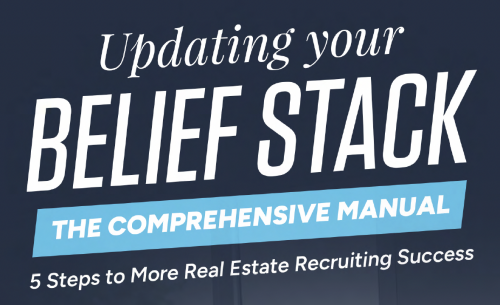
Mark recently published a second edition to his popular e-book Updating Your Belief Stack.
This e-book that will walk you through this process.
It starts with focusing on just one goal (e.g., improving your recruiting results) but can be expanded to multiple professional objectives.
By completing this step-by-step guide, you’ll be on your way to changing both your beliefs and the outcomes you hope to achieve.
Download your copy now and get started on improving your results!